
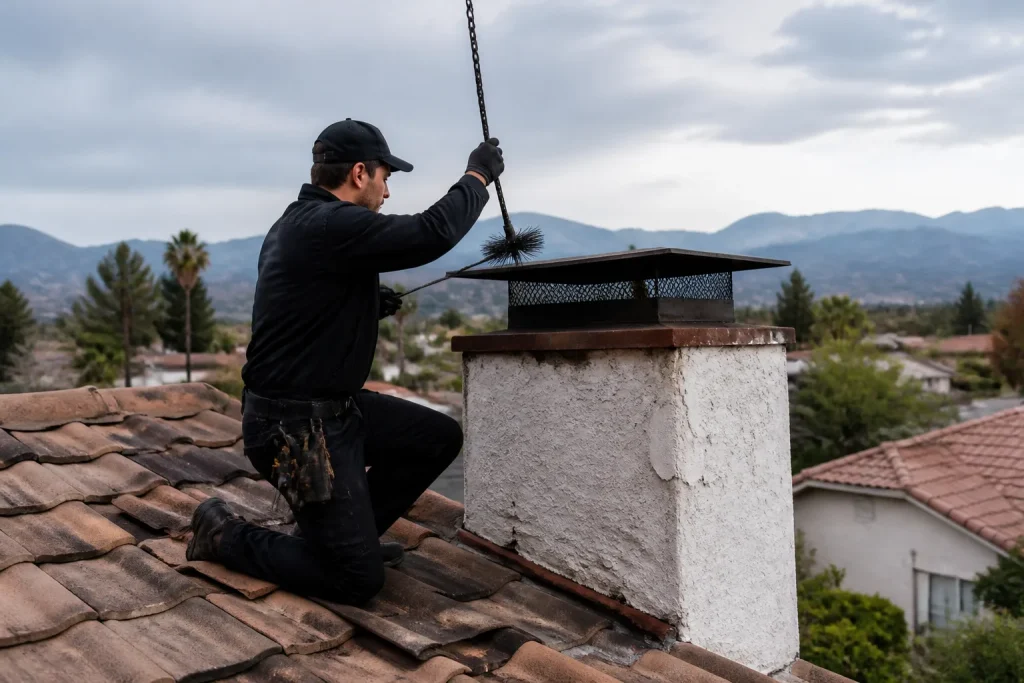
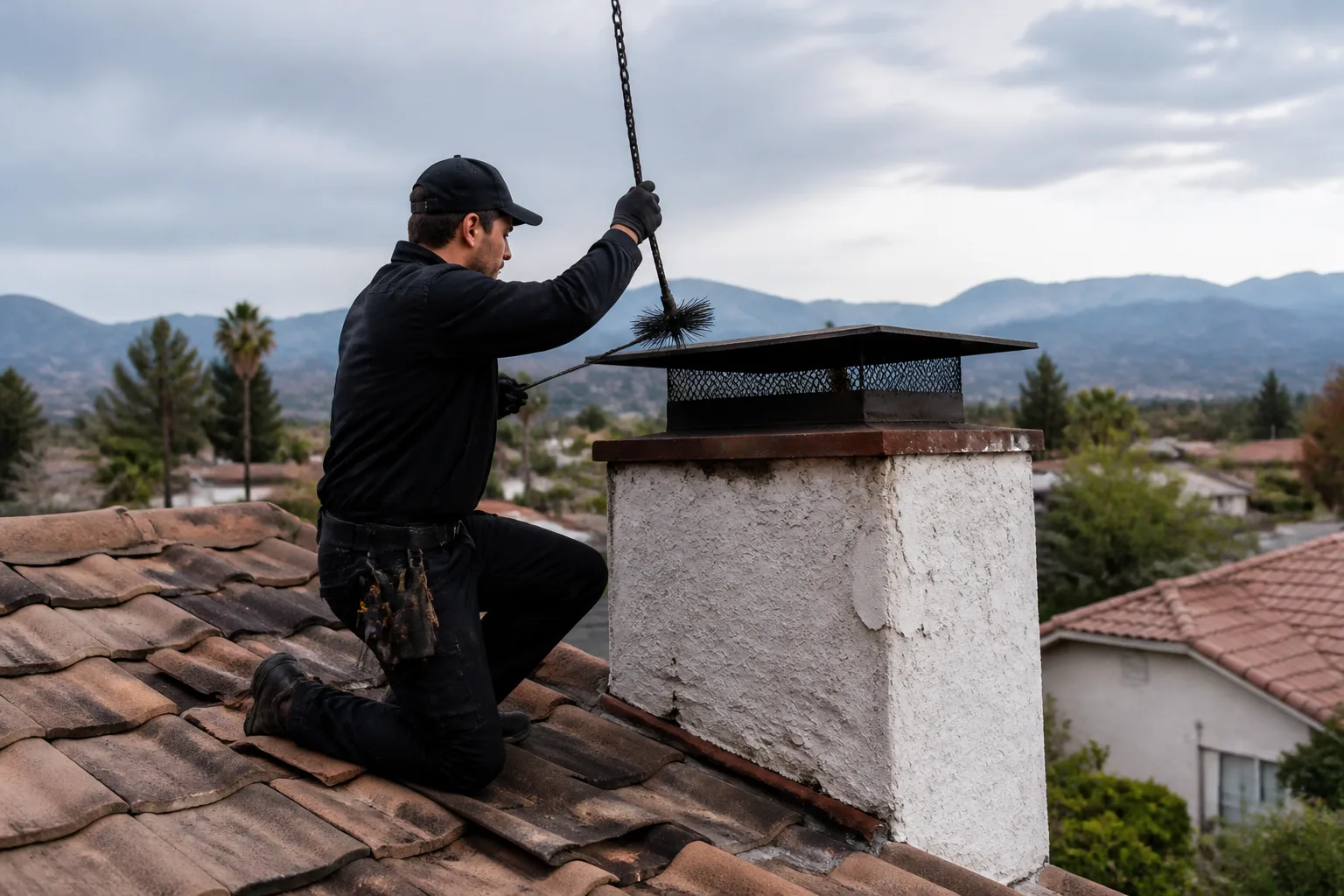
Emergency Chimney Sweep Near Me: What Rialto Homeowners Should Do First
If you’re searching “emergency chimney sweep near me” in Rialto, here’s the straight answer: stop using the fireplace immediately, close the damper if it’s safe to reach, and call your insurance company before you call a sweep. The first hour after a chimney problem determines whether you’re dealing with a $200 cleaning or a $6,000 rebuild. And if you’d rather skip straight to professional help, call Chestnut Chimney Sweep home at (855) 360-4975.
The Sequence Nobody Tells You About
Most Rialto homeowners do this backwards. They spot smoke backing into the living room, panic, and call the first chimney company that picks up. What they don’t realize is that insurance adjusters want to see the flue before anyone disturbs it. Once a sweep runs brushes through, scrapes creosote, or disassembles a damper, the evidence of what actually happened gets muddied.
The correct order is this:
- Stop feeding the fire. Close the glass doors if you have them. Do not throw water on a chimney fire, it can crack the flue liner instantly.
- Close the damper only if you can reach it without getting near the fireplace opening. This cuts oxygen to any active fire in the flue.
- Evacuate if you see flames above the chimney cap or hear a roar that sounds like a freight train. That’s a chimney fire in full burn, not a smoke issue.
- Call 911 for an active fire, then your insurance company once it’s out. Take photos before anyone touches anything.
- Then call a chimney professional for an emergency inspection. That’s the sequence, and skipping steps 2 through 4 is how small problems become insurance denials.
We’ve worked in enough Rialto homes over in the Las Colinas and Sunridge neighborhoods to know that most “emergencies” are actually smoldering creosote events, not full fires. But the protocol is the same either way: assess, document, then repair.
Three Real Chimney Emergencies (And What Each Actually Requires)
Not every urgent call is the same emergency. The phrase “emergency chimney sweep” gets thrown around a lot in Rialto, but operationally it means different things depending on what’s happening. Here’s what we tell homeowners for each scenario.
1. Active Chimney Fire
This is the only true “call 911” situation. A chimney fire burns at 2,000 degrees or hotter. Liners crack. Mortar joints fail. Flames can shoot out the top and ignite your roof or nearby trees. Once the fire department clears the scene, the chimney is not safe to use until someone performs a Level 2 inspection, which typically includes a camera scan of the entire flue. In Rialto, where many homes were built in the 1980s and 1990s with clay tile liners, those liners often have hairline cracks from decades of thermal cycling even before a fire hits. After a chimney fire, those cracks widen and become channels for heat transfer into framing.
What to do: document everything. Take photos of the fireplace interior, the damper, any soot on the hearth, and the chimney exterior. Your adjuster will want to see the before-state. Then schedule an inspection. The sweep’s job at this stage is not to clean. It’s to assess whether the flue is structurally sound or needs a liner like a DuraFlex stainless system.
2. Smoke Backing Into the Home
Smoke rolling back into the living room during normal use usually means one of three things: a blocked flue, negative air pressure inside the home, or a failing damper. In Rialto, we see a lot of the first one, birds, squirrels, and raccoons love chimney flues. A blocked flue isn’t technically an emergency unless it’s actively pushing carbon monoxide or smoke into occupied rooms.
What to do: open a window near the fireplace. That sounds backwards, but it often equalizes pressure quickly. If smoke still backs up, close everything down and call for an inspection. A camera scan will show whether you’re dealing with a nest, a collapsed tile, or a damper that’s rusted half-shut. If it’s a damper issue, we often replace with Copperfield components because they seat tightly and don’t warp the way cheap castings do.
3. Post-Earthquake Structural Concern
This is the emergency category that’s uniquely relevant to Rialto. The city sits near the San Jacinto Fault Zone, and we’ve felt enough moderate shakers to know what they do to chimneys. Brick chimneys can shift. Clay liners crack. Mortar joints loosen. You won’t necessarily see the damage from the ground.
What to do after a tremor: inspect from the yard first. Look for visible leaning, new cracks in the brick, or shifted cap stones. Do not use the fireplace until a full inspection clears it. Even a small shift can create a gap between flue tiles, and that’s where heat reaches combustible framing. In our experience, post-quake inspections in Rialto frequently reveal the need for HeatShield restoration rather than full rebuilds, which saves homeowners thousands and keeps the original masonry intact.
What “Emergency Chimney Sweep” Actually Means
Here’s the part most marketing copy won’t tell you. When a chimney company advertises “emergency service,” it usually means they’ll answer the phone after hours. It does not mean they’ll arrive with a full repair truck at 11 p.m. and rebuild your flue before sunrise.
The operational reality breaks down like this:
- Emergency inspection is the first appointment. Someone comes out, does a visual and camera assessment, and tells you whether the system is safe to use. This can often happen same-day or next-day.
- Emergency repair is a second appointment, sometimes days later, because parts have to be ordered. DuraFlex liners, Copperfield caps, and HeatShield materials aren’t sitting on a shelf at a hardware store in Rialto. A reputable company specs the right product for your flue size and fuel type, and that takes lead time.
Any company that promises to fully repair a chimney the same night is either lying or using unlisted, generic parts. We will not do that. The parts matter as much as the labor, which is why we carry name-brand components every time.
Documenting Damage Before the Sweep Arrives: A Photo Checklist
Your insurance claim lives or dies on documentation. Most Rialto homeowners take two blurry photos of the hearth and figure that’s enough. It isn’t. Here’s what actually helps the adjuster approve the claim:
- Fireplace interior, straight on. Get the firebox, the damper frame, and the first few feet of flue if visible.
- The chimney exterior from all four sides. Use a ladder or zoom lens. We need to see brick condition, cap condition, and any visible cracks.
- Any soot or smoke staining on walls, ceilings, or the mantel. This proves combustion byproducts breached the system.
- Close-ups of any cracked brick, shifted masonry, or deteriorated mortar joints. Put a coin or ruler in frame for scale.
- The flue cap and crown from the roof, if you can safely access it. Do not climb onto a post-fire or post-earthquake roof if there’s visible structural damage.
And critically: don’t sweep it yourself. Don’t run a wire brush up there to “help.” You’ll destroy the creosote pattern that tells an investigator how the fire burned and how hot it got. We’ve had claims delayed because a homeowner decided to tidy up first.
When to Call a Pro (And When to Wait)
The honest answer is that not every smoke wisp needs an emergency call-out. If you light a fire, get a little smoke for the first minute, and then it draws normally, that’s likely just a cold flue. Open a window, add a little newspaper to get the updraft moving, and watch it.
But you should call a professional Rialto chimney sweep that same day if:
- Smoke keeps pouring into the room after the fire is established
- You smell smoke in rooms other than where the fireplace is
- You hear crackling or roaring sounds from inside the chimney
- You see visible flames above the chimney cap
- You feel an earthquake strong enough to rattle dishes, and the chimney is masonry
- Your carbon monoxide detector goes off, full stop
If you’re in that last category, leave the house, call the fire department, and don’t go back in until they clear it. Carbon monoxide is odorless, colorless, and kills faster than a chimney fire.
For Chimney Repair in Rialto, we’ll assess the full stack, from firebox to cap, and spec the right materials. That might mean DuraFlex for a reline, HeatShield for a restoration, or Copperfield for cap and damper work. It depends on what the camera shows, and we’ll show you the footage. No recommendations based on “we think it might be bad in there.” You’ll see it with your own eyes.
The Bottom Line
An emergency chimney situation in Rialto has a correct first move, and it isn’t picking up the phone to a sweep. It’s stopping the fire, closing the damper, calling insurance, and documenting what you see. Once that’s done, call a specialist for an emergency inspection. From there, the scope of repair depends on what the camera finds. Could be a simple sweep. Could be a HeatShield liner restoration. Could be a full DuraFlex reline. You’ll know exactly which because we’ll show you the video. If you’re in Rialto and you need help, Chimney Sweep in Rialto services from Chestnut Chimney Sweep are a call away. We offer free estimates at (855) 360-4975.
And while we’re on the subject of fire hazards in the home, don’t forget about your dryer vent. Lint is just creosote with a fabric softener scent. Same mechanism, same risk, different appliance. If your dryer is taking two cycles to finish a load, the vent is clogged, and that’s a fire waiting to happen. We handle Dryer Vent Cleaning in Rialto as a fire-safety service, not an add-on, using Famco-grade venting knowledge that treats the dryer exhaust as seriously as the chimney flue. One call covers your chimney and your dryer vent, two of the most overlooked fire hazards in a home.
Frequently Asked Questions
Emergency inspection pricing in Rialto typically runs higher than a standard sweep because it involves camera work and a full assessment, not just brush work. Expect to pay a premium for same-day or next-day availability, and understand that the inspection fee is separate from any repair quote. Call (855) 360-4975 for an exact quote; we give flat pricing before we arrive.
Yes. Without a camera scan, you cannot see hairline cracks in clay flue tiles, and those cracks are exactly what allows heat to reach framing and start a house fire. A visual inspection from the top and bottom won’t catch mid-flue damage. If a company says they can “just clean it and you’ll be fine” after a chimney fire, hang up and call a specialist who uses cameras.
Once a year if you burn wood regularly, even if it’s just weekend fires in the winter. Creosote builds up invisibly, and Rialto’s dry air plus occasional Santa Ana winds create ideal conditions for that creosote to ignite. Gas fireplaces can go longer between cleanings, but an annual inspection is still smart. Pellet stoves need the most frequent attention because pellet ash is fine and coats the flue quickly.
Two scenarios. Best case, nothing happens for years, and you got lucky. Worst case, a cracked flue tile lets a small ember reach roof framing during your next fire, and you’re dealing with a house fire that started inside the wall. The risk isn’t theoretical. In Rialto, where seismic activity is a fact of life, the cost of an inspection is trivial compared to what a structural failure costs. We won’t tell you to replace things that don’t need replacing, we’ll show you the footage and let you decide. Call (855) 360-4975 and we’ll set it up.
Written by the team at Chestnut Chimney Sweep, serving Rialto since 2012.
Need Chimney Cleaning Help?
Call Chestnut Chimney Sweep — licensed & insured, here with fast after-hours help in Rialto.
(855) 360-4975